
Meta's Advantage+ Auto-Translation Feature Is Breaking Video Ads
I was looking for cold-call leads in the Meta Ad Library. Instead I found Meta machine-translating a brand's video ad into 17 languages. It splits words in the middle, drops every accent from the Greek version, and in Danish it dubs a mistranslation straight into the voice track.
I was just looking for leads
Full disclosure up front: I run OutCaps, a subtitle localization engine, and I prospect for customers in the Meta Ad Library. The EU transparency rules let you see which countries a brand targets and every localized variation of its ads. My usual pattern-match is simple: find brands pushing one version of a video, an English original with English subtitles, into France, Italy and Spain. Then I contact them.
Some brands still do exactly this. Others have shifted entirely to local UGC content. And then I hit a yoga app (they stay anonymous here) running something I hadn't seen before: one English UGC-style ad, pushed into other markets with Advantage+ as 18 versions. The original plus 17 auto-generated ones. Meta transcribes the original, machine-translates it, burns auto-generated subtitles into each variant, and for the Danish version I pulled it even synthesizes a dubbed voice track on top. I don't speak Danish, so I can't tell you how robotic it sounds. Turned out that didn't matter anyway.
Meta previews only one video variant, but it shows a screenshot from each of the 18 language versions. German is my mother tongue. One German screenshot alone had three errors.
Building a ground truth
In order to make sure I wasn't judging from a thumbnail, I downloaded all 18 ad variants and transcribed the English original with our own engine. It came back clean and complete. Natural UGC English, every sentence fine. That transcript is the ground truth, and every language version below is matched against it by timestamp. The result is devastating and funny at the same time:
| Version | The original line (English) | What Meta generated | What went wrong |
|---|---|---|---|
| German subtitle | “Consistency is the key, girl.” | „…dranbleiben ist der Schlü ssel malet" | „Schlüssel" is split in half across the line break — and the caption ends in „malet", a word that belongs to neither German nor the original sentence. |
| Swedish subtitle | “Day 21, I'm starting to notice real changes around my waistline.” | „jag börjar märka icke platsfö rändringar runt midjan" | „platsförändringar" is split mid-word — and “changes around my waistline” became “place-changes”, as in geographical relocation. Moving to a new house, essentially. |
| Greek subtitle | “Day 7. Okay. I didn't expect this.” | „το σμα μου βδομη μρα εντξει δεν το περμενα" | Every accented vowel is missing: σώμα→σμα, έβδομη→βδομη, μέρα→μρα, εντάξει→εντξει, περίμενα→περμενα. The renderer drops accented Greek characters wholesale. |
| Norwegian subtitle | “I told my friend she could lose 10 kilos in 28 days…” | „jeg sa til venninnen min at hun kunne gå ned ti" | The caption simply stops mid-phrase — „ti" is the first half of „ti kilo" (10 kilos). The rest of the sentence never appears. |
| Danish subtitle | “…and my clothes are starting to fit better.” | „…og mit tø j begynder og sidde bedre" | „tøj" (clothes) is split mid-word — a three-letter word, cut in half. |
| Danish dubbed audio | “Consistency is the key, girl. Good job.” | „vil holdningen af nøgen tigger godt gå" | The translation is grammatical nonsense — roughly “will the posture of naked beggar well go” — and the synthetic voice-over speaks it aloud in the ad. |
The last row is the one that still amazes me. I verified it by running the Danish variant's audio back through our engine, and it transcribed, phonetically, exactly that gibberish. The mistranslation didn't stay in the text layer. It was synthesized into the ad's voice track and shipped to Danish viewers.
Straight from the Ad Library, no cap!
Ad Library cards for the original and four of the auto-generated versions, captured in July 2026 (advertiser redacted). The counter in each card is Meta's own — “X of 18”:


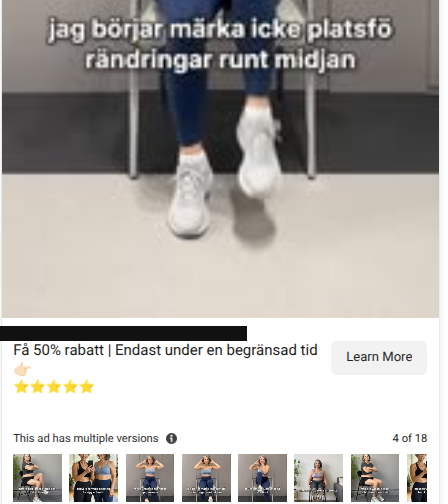
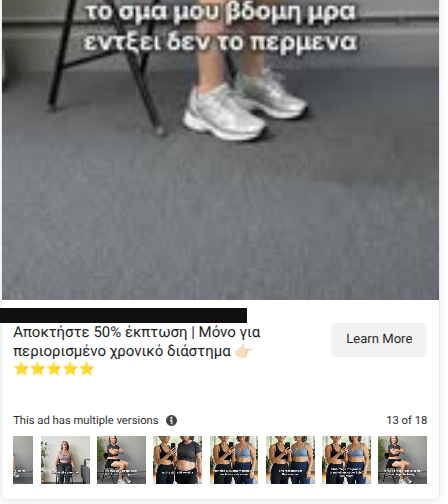

And the frames that turn this from a subtitle bug into something bigger. Same seconds of the ad, original versus the Danish auto-dub:



It's rolled out, and it's costing advertisers money
My first thought was honestly: great, I can help all of these brands. My second thought was: wait, is Meta really shipping this without proper testing?
Then I found Business Insider's reporting from 13 July (subscriber wall). Eight advertisers and agency people describe Meta's AI ad tools as routinely broken. The outdoor retailer REI ran an Instagram ad showing a nonsensical bike with two handlebars, and said Meta had „auto-enrolled" it into the feature that generated it. One consultant watched Meta turn a client's pajama dress into a shirt and pants, and add men to an ad for a women's networking group. An agency director says a bug that switches AI settings on has hit most of the 15 clients whose Meta advertising she runs. Meta's answer, through a spokesperson, is that its terms say AI can make mistakes and that checking the output is the advertiser's job.
Now notice what is not in that reporting: the translation layer. The coverage so far is about AI rewriting images. Nobody has looked at what happens when the same automation rewrites the words, in languages the advertiser doesn't speak. That is what the screenshots above show.
After posting this on r/FacebookAds, a media buyer added the numbers I couldn't: after roughly three weeks with auto-translation active on a US-only lead-gen campaign, their CPA climbed from $22 to $41 before they caught it. The mechanism matches what I saw in the Ad Library. The feature localizes by the viewer's device language, not their location, so a Spanish-language device in Ohio gets an auto-dubbed variant with a robotic voiceover. In their account, conversion rate on those impressions dropped by roughly 60%. After switching the feature off and rebuilding with per-language ad sets, CPA recovered within days. Their full breakdown is in the thread.
How to check your own campaigns (even if you think you don't use it)
- Find the switch to deactivate. Auto-translation and auto-dubbing sit under asset customization at the ad-set level. If you never consciously enabled them, check anyway. Advertisers in the Reddit thread report being opted in, REI told Business Insider it had been „auto-enrolled" into an AI feature, and an agency director quoted in the same piece says a bug switching these settings on hit most of her Meta clients.
- Break down performance by language. The standard breakdown columns will not surface this. Add the language breakdown manually and compare conversion rates on translated impressions against your original.
- Audit yourself in the Ad Library. Look yourself up and open every localized screenshot. Five minutes, and you see exactly what your prospects in each market see.
- If you want localized ads, localize deliberately. Per-language ad sets with reviewed subtitles, whoever produces them, will beat an unreviewed black box in every language you actually care about.
Obviously, I'm not neutral at all
I enjoyed having a better angle to help. I sell subtitle localization and I found all of this while prospecting for customers, so judge the screenshots yourself. But the takeaway doesn't depend on whose tool you use: readable, correct subtitles in a viewer's own language are a conversion lever, and about 85% of people watch ads on mute. Meta clearly agrees, or it wouldn't have built the feature. It just shipped it before it worked.
One honest footnote from the audit itself: our own engine didn't magically repair anything when we fed it Meta's broken Danish dub. It transcribed the gibberish the synthetic voice actually says, and it dropped a seven-second stretch of the TTS audio entirely. ASR gives you back what the audio contains. That's the whole point. The translation has to be right before it gets burned into pixels or spoken by a synthetic voice.
Disclaimer: Meta®, Advantage+ and the Meta Ad Library are trademarks of Meta Platforms, Inc.; no affiliation or endorsement is implied. Observations were made in the EU Ad Library in July 2026 and reflect the feature's behavior at that time; card screenshots and video frames come from the publicly listed ad variants, with the advertiser anonymized. Third-party campaign figures are as reported by their authors in the linked thread.